
Sadly, the rumors are true and the Kilgarlin Center is no more. As such, I am moving this blog to a new address to archive it for as long as I can. Please change your bookmarks/links to the new address:
Map of the Land of Books (in German!)

From the Strange Maps blog comes this gem of a map!
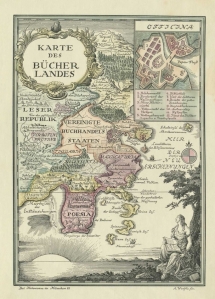
“This map by German illustrator Alphons Woelfle (1938) shows the extent and the divisions of Bücherland (the Land of Books). The Land consists of about half a dozen distinct territories, most of which are explicitly named: Leserrepublik (Reader’s Republic), Vereinigte Buchhandelsstaaten (United States of Booksellers), Recensentia (a realm for Reviewers), Makulaturia (Waste Paper Land), and Poesia (Poetry). The capital of the US of B is the city of Officina (Latin for workshop, and the origin of our ‘office’; the name seems remarkably unremarkable. Possibly there is an old reference or a German word-joke here we’re not getting).”
Source: Strange Maps
Filed under Amusements
Video roundup (or: No, this blog isn’t dead!)
Here are some recent videos that have been brought to my attention – they may be relevant to your interests!
- Atelier: Ex Libris
“As a bookbinder and manuscript restorer specializing in medieval bindings it is a joy for me, now and then, to make small versions of historical bindings for myself or for treasured friends, as in fact, this one is. I decided to make this clip as the most beautiful part of the book is not what you see (as is usually the case) but what is hidden in countless hours of work underneath the surface which you will never see. The work, seen and unseen, took approximately 50 hours.
The clip will take you through all of the steps from just after the paper was painstakingly torn individually and laid into quires to the completion of the clasps. It is modelled after a 15th Century Gothic binding.” - PBS’s American Experience: “A Class Apart: A Mexican American Civil Rights Story“
This originally aired on Feburary 23rd, but you can watch the whole thing online right now! It includes archival materials from the Center for American History and the Benson Latin American Collection. At least a couple of Kilgarlin students have worked for the Benson, including the talented Sarah Norris. In addition, many other students have done treatments on items from the Center for American History. Also, this episode is narrated by Edward James Olmos, aka Admiral Adama from Battlestar Galactica, aka star of the most-awesome-film-about-a-math-teacher, “Stand and Deliver“. - Drop-lining of the big, stinky map of Evanston
While interning at the Northwestern University Library, I’ve had the pleasure of working on not only the oldest, but also the largest and stinkiest map of Evanston I’ve ever had the (mis)fortune to smell. This map was not only filthy (dirt, insects AND bird poop), it was varnished, lined and shattering like Blagojevich’s political career. Special Collections conservator Susan Russick (also a Kilgarlin alum) has been leading the treatment, and after we washed the map, she taught me how to do a “drop lining” using a stick and a pasted-up sheet of Japanese tissue. That’s her climbing onto the table, since I am too short to lift the stick up high enough to get the tissue onto the table all the way.
ATTENTION: if anyone has any videos they’d like to have thrown onto the great stage that is the internet, PLEASE send them to me, or post a comment.
Filed under Uncategorized
Giant squids and the alphabet
Here are two videos of amazing pop-up books! The first video shows how a “20,000 Leagues Under the Sea” pop-up book was engineered. The second shows an incredible new pop-up book called ABC3D (available from Amazon for only $12!!) – this same video was posted a while back, but since I just bought it I thought it’d be good to show it again. 😀
Filed under Book Arts
Awesome personal library
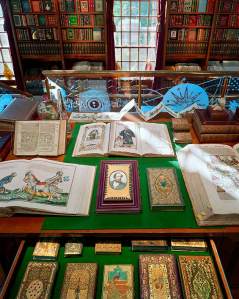
Check out Wired magazine’s profile of the personal library of Internet entrepreneur, Jay Walker. The pictures are incredible, and I may never get over the envy.
I heard it on NPR: Web Security Words Help Digitize Old Books
I heard an interesting story on NPR about a service called reCAPTCHA that has harnessed the power of the masses (and the internet) to improve the OCR output for digitized books available on the Internet Archive as well as old issues of the New York Times.
From the reCAPTCHA website:
reCAPTCHA improves the process of digitizing books by sending words that cannot be read by computers to the Web in the form of CAPTCHAs for humans to decipher. More specifically, each word that cannot be read correctly by OCR is placed on an image and used as a CAPTCHA. This is possible because most OCR programs alert you when a word cannot be read correctly.
But if a computer can’t read such a CAPTCHA, how does the system know the correct answer to the puzzle? Here’s how: Each new word that cannot be read correctly by OCR is given to a user in conjunction with another word for which the answer is already known. The user is then asked to read both words. If they solve the one for which the answer is known, the system assumes their answer is correct for the new one. The system then gives the new image to a number of other people to determine, with higher confidence, whether the original answer was correct.
You can listen to the NPR story here.
Filed under Uncategorized
ABC For Book Collectors
Through the good graces of Oak Knoll Books and the British Library, the full text of John Carter’s ABC For Book Collectors is now available as a free PDF. It’s a great introduction to all the different parts of a book, and a reference I’ve used many times as a student.
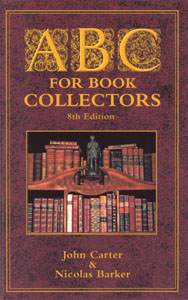
Cover of ABC for Book Collectors
Filed under Conservation Resources
Librarian video roundup!
At last! Videos of this year’s ALA Book Cart Drill Team Championships are online! This was one of the not-to-be-missed events of ALA…lucky me, I snagged a seat in the 2nd row and what a ride it was!
In first place were the “Well Stacked Sci-brarians” from the Santa Monica Public Library.
More videos after the jump…
Continue reading
Filed under Uncategorized
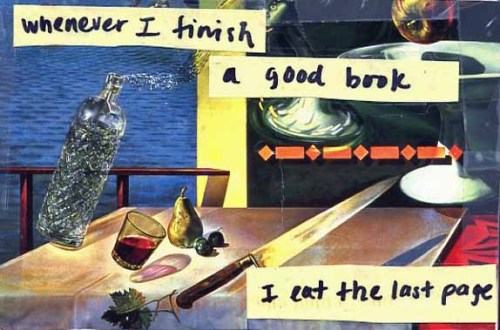
John Frederick Peto, Painter of Book Carnage
During my recent trip to California for the ALA 2008 conference, I visited several of the museums in San Diego’s Balboa Park. One of my favorite paintings I saw that day was at the Timken Museum of Art – it was a work by John Frederick Peto, an American tromp l’oeil painter. Titled “In the Library”, the painting depicts a sad and sorry collection of ragged books. In fact, many of Peto’s paintings depict groups of abused tomes sorely in need of a conservator’s loving touch. He is also fond of depicting paper ephemera and photographs mercilessly given the “bulletin board” treatment.

John Frederick Peto, "Take Your Choice"
Filed under Uncategorized
 Kilgarlin Center Denizens